Makkahمكة المكرمة
Inside the designated zones, and only for Muslim non-Saudis. Which zones, what share may be held and for how long are all on the REGA portal rather than here.
O My bondmen who believe! Lo! My earth is spacious. Therefor serve Me only.Qur'an 29:56 · Pickthall
In build
A free, independent guide to relocating to Saudi Arabia, centred on Makkah and Madinah. It sells nothing, gates nothing and collects nothing.
Four doors into Saudi Arabia. Employment, Residency, Business and Investment — each one leading to a permit, and every permit to the same trunk.
Four ways in, and that is how people arrive and how they describe themselves. Underneath there are only two permits, and it is worth knowing which one you are heading for before you start.
An employer sponsors you, and the permit is an iqama tied to that employer. The route cannot be started alone: the employer holds the quota, obtains the authorisation and issues the iqama.
You pay for the right to reside. No employer, no company. This is Premium Residency, applied for directly.
You set up or move a company, and the company qualifies you. The permit at the end is Premium Residency.
You put capital in, including into property, and the holding qualifies you. The permit at the end is Premium Residency.
Source Premium Residency service, Saudi National Portal checked 2026-08-30
Source Premium Residency Permit Law, Article 2, Ministry of Investment checked 2026-08-30
Royal Decree M/14 was issued on 14 July 2025 and came into force on 22 January 2026. The Council of Ministers approved the Executive Regulation and the Geographic Scope Document on 23 June 2026 — the regime only became usable on that date.
Muslim non-Saudis may hold title in Makkah and Madinah, resident or not. That is the real change: the position before was effectively leasehold only.
Ownership in the two cities is confined to zones designated by the Council of Ministers and mapped by REGA. Registration, payment and title issuance all run through one REGA platform.
A non-Saudi resident may also own one residential property outside the designated zones for personal use. Makkah and Madinah are excepted from that allowance. Someone living abroad is confined to the zones.
For a company, what matters is where it is incorporated, not who owns it. A company incorporated in Saudi Arabia is not treated as non-Saudi under M/14 even if it is wholly foreign-owned, so it may hold property in the two cities. The purpose is limited: business use and staff accommodation, not investment. That is a wider permission than any individual non-Muslim has, which is why how you are structured sits upstream of the property question.
REGA has left the door open to designating further zones, and has not said when.
Both of these are REGA's own, and both answer a question this page can only describe.
Real Estate General Authority (REGA), Saudi Properties
Checks whether a named beneficiary may own, before any money or paperwork moves. Free, and answered immediately.
A beneficiary ID and date of birth. Nothing on this site can stand in for it.
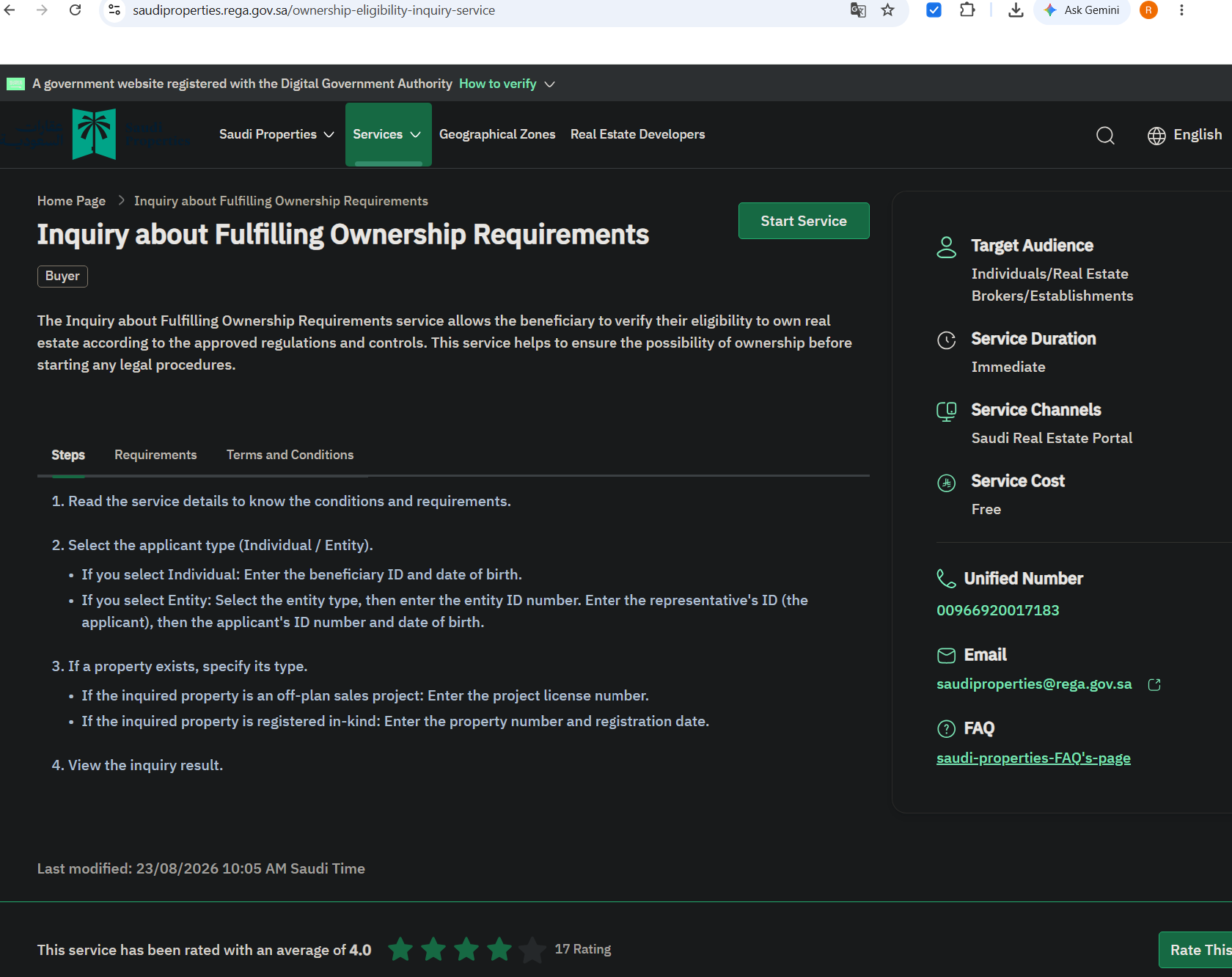
Real Estate General Authority (REGA), Saudi Properties
The designated zones themselves, on REGA's own map, with the terms attached to each.
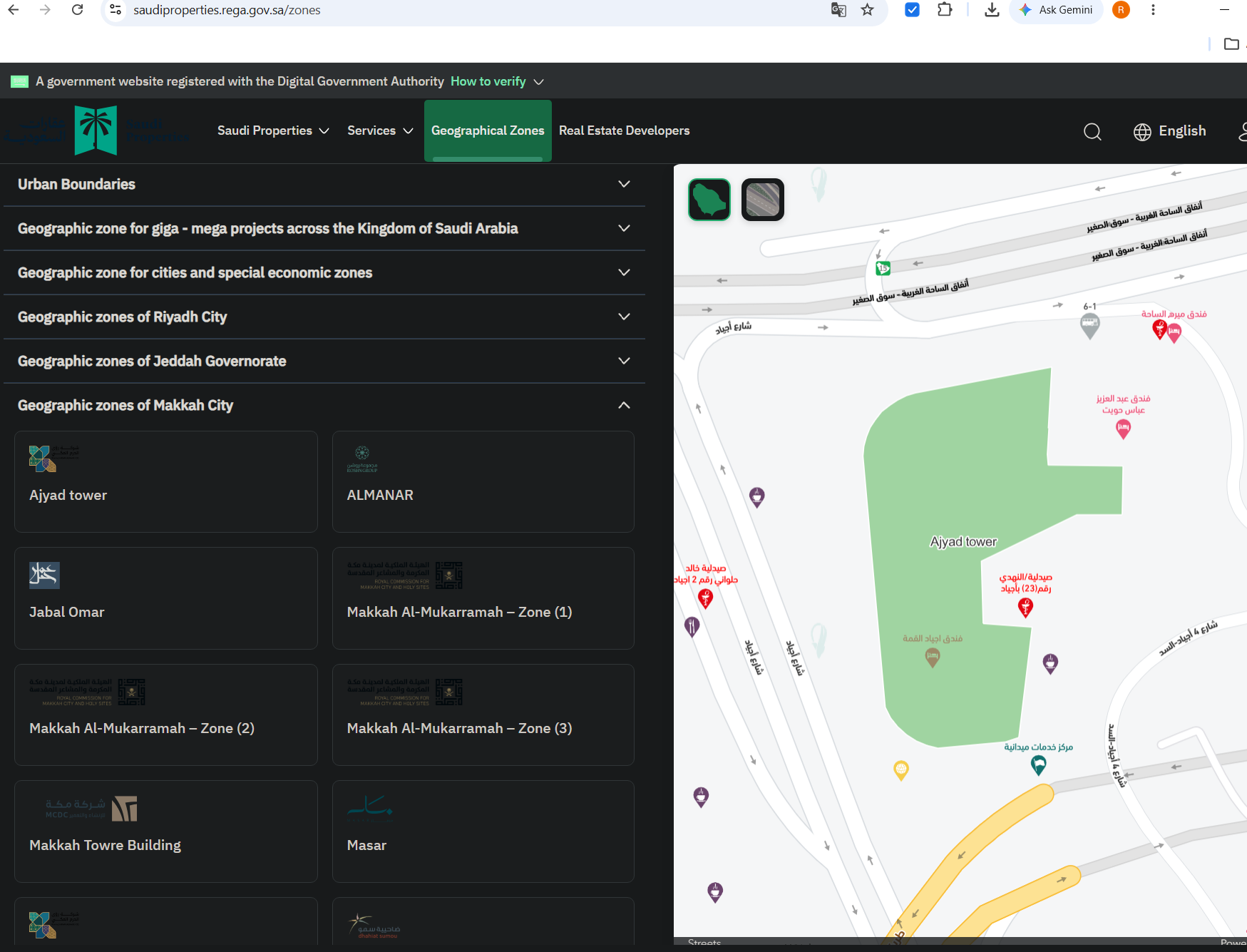
Whether a non-Saudi may buy in any given area is defined by REGA’s Geographical Zones Document, not by any band or map on this page. REGA non-Saudi ownership zones portal. The boundaries are not reproduced here. The portal is the only place they are current, and a stale copy of a line on a map could cost somebody a purchase.
No map is loaded when this page opens. Each map is a button until you press it, and pressing it is the first and only moment Google is told anything about your visit.
Not districts, and not neighbourhoods. Each designated zone is a named development, listed on REGA's portal with its own map and its own terms.
Usufruct is a right to use and take the benefit of a property for a fixed term. It is not ownership, and the two sit side by side in REGA's terms rather than being alternatives to each other.
Read off REGA's portal on the date above. The portal is the authority and this list is not — it is here so a reader knows what kind of thing a zone is before they open the map, and it will drift the moment REGA designates another one.
Names are as REGA spells them, including where that differs from what you might expect. A development's name is an identifier, and correcting it here would make it harder to match against the portal, not easier.
Source Real Estate General Authority (REGA), Saudi Properties checked 2026-08-31The portal holds the official interactive zone maps, the permitted ownership percentages, the rights types and the duration limits. It is the authority on all of them; property blogs are not.
Inside the designated zones, and only for Muslim non-Saudis. Which zones, what share may be held and for how long are all on the REGA portal rather than here.
The same rule as Makkah: designated zones, Muslim non-Saudis, and the portal as the authority on the boundaries.
Distance from the Haram is the decision underneath the decision. It is not really about the commute — it is about how often you go, and whether the Haram is part of an ordinary week or a trip you save up for.
Every prayer, if you want it. You go because you are passing, not because you planned to.
Fajr and Isha most days, if the shuttle runs when you need it. The decision to go is a small one but it is still a decision.
Jumu'ah, and the nights you set aside for it. The Haram becomes something you go to rather than something you are near.
Getting in is one problem. Trading once you are there is a different one, and the part people get wrong happens before any of it — at the moment they pick what their company is allowed to do.
Your business activity is registered under an ISIC4 classification, and that single choice sets the capital requirement, the ownership ceiling, which regulator has to co-approve you, and what you may lawfully sell. It is not an administrative label attached to a business you have already designed. It is the constraint the business has to be designed around.
Getting it wrong is not fatal and it is not cheap. Reclassifying later means amendment fees, an update to the Commercial Registration, and usually a fresh attestation cycle for the parent-company documents — so it costs less to be right the first time than to correct it afterwards.
Full foreign ownership is available across most activities, subject to an excluded-activities list. Which list you fall on is decided by the classification too.
Small and Medium Enterprises General Authority
The main way in for a small business. It runs a financing gateway, the Kafalah credit guarantee, an academy, a franchise centre, Jadeer pre-qualification, and business facilitation offices.
Most small and medium businesses, whatever the sector.
Saudi Industrial Development Fund
Development finance for industrial and manufacturing projects rather than for trading or services.
Anyone building or making something.
Ministry of Finance procurement platform
Where government buys. It carries mandatory set-asides reserving part of public procurement for small and medium businesses.
Anyone who wants the government as a customer.
A foreign founder can reach these programmes, but generally only through a company registered in the Kingdom. None of them is a route in on its own — they are what becomes available once you are already through one of the four doors, which is why they sit here and not on the map.
The Ministry of Investment is the front door for a foreign-owned company, and both of these are its own pages rather than a summary of them.
Ministry of Investment of Saudi Arabia (MISA)
New investor registration, the current investor account, and MISA's own investor guide in English and Arabic.
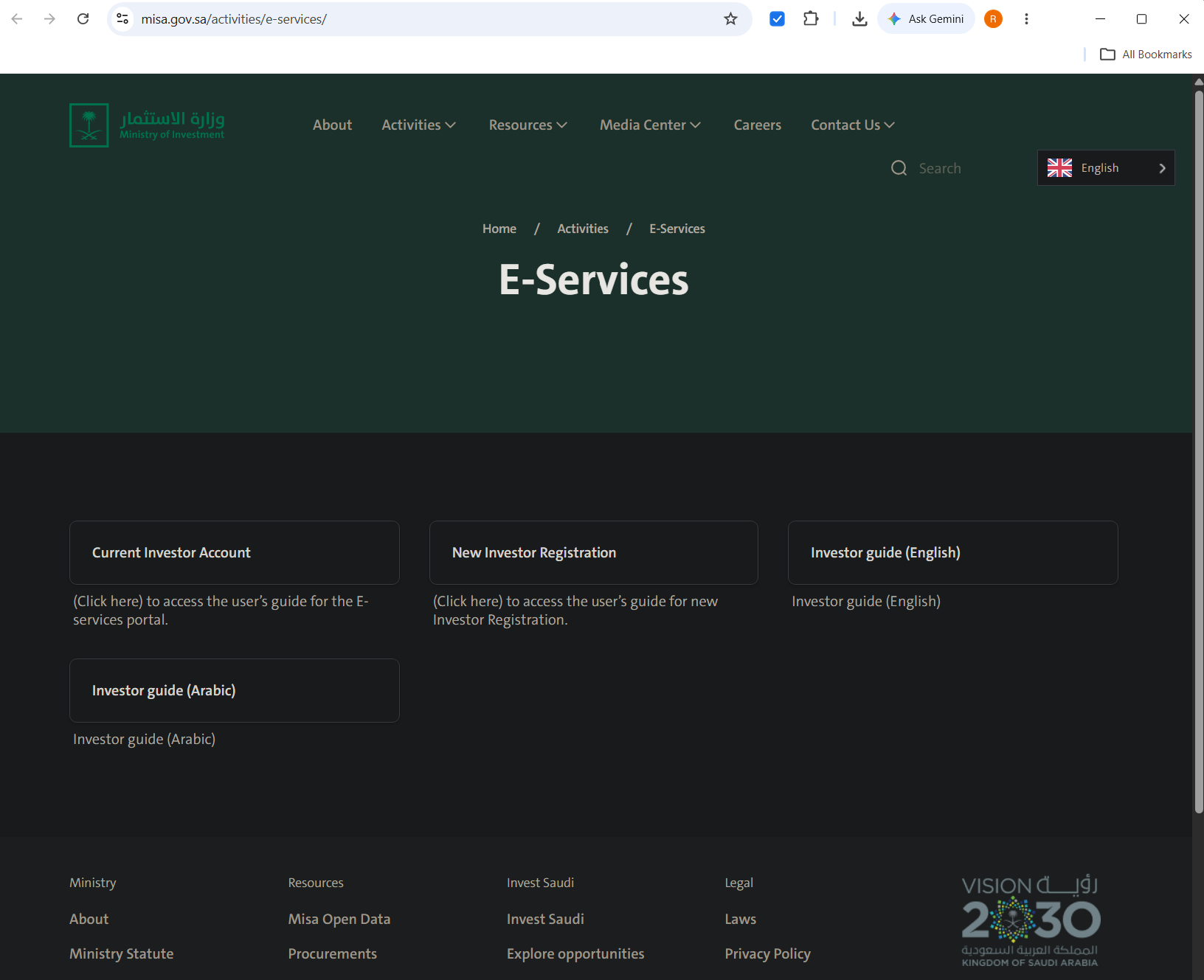
Ministry of Investment of Saudi Arabia (MISA)
What MISA will actually do for an investor, and the sectors it has people for.
Source Monsha'at, Small and Medium Enterprises General Authority — link and check date still to be recorded
Source Saudi Industrial Development Fund, SIDF — link and check date still to be recorded
Source Etimad, Ministry of Finance — link and check date still to be recordedThe activity-classification rules sit with the Ministry of Investment; the programmes above each publish their own criteria. None of these pages has been opened, so none of them is shown as checked.
There is no honest single number for this. What follows is four structural facts, chosen because each one changes a relocation decision on its own — and no index, because the index everyone reaches for is crowd-sourced and licence-restricted.
| Saudi Arabia | LondonNew YorkTokyoIslamabadDelhiDubai | ||||||
|---|---|---|---|---|---|---|---|
| Tax on employment incomeThis does more work than any cost-of-living comparison, because it changes take-home pay directly rather than estimating what things cost. | None. | Income tax, plus National Insurance. | Federal, plus state, plus city. | National income tax, plus a residence tax. | Income tax. | Income tax. | None. |
| Tax on what you buyThe shape differs more than the rate does, and the shape is what you can state honestly without a source for every jurisdiction. | VAT, one standard rate nationally. | VAT, one standard rate nationally.The rates themselves are not printed here. Each one needs its own national tax authority as a source and a date it was last checked, and none of them has been read yet. | No federal sales tax. New York City levies a combined state and city rate.The rates themselves are not printed here. Each one needs its own national tax authority as a source and a date it was last checked, and none of them has been read yet. | Consumption tax, one standard rate nationally.The rates themselves are not printed here. Each one needs its own national tax authority as a source and a date it was last checked, and none of them has been read yet. | GST, banded.The rates themselves are not printed here. Each one needs its own national tax authority as a source and a date it was last checked, and none of them has been read yet. | GST, banded.The rates themselves are not printed here. Each one needs its own national tax authority as a source and a date it was last checked, and none of them has been read yet. | VAT, one standard rate nationally.The rates themselves are not printed here. Each one needs its own national tax authority as a source and a date it was last checked, and none of them has been read yet. |
| Housing and schoolingThis is the row that stops the rest of the page being read naively: the same headline salary is not the same money. | Frequently part of an employment package. | Rarely part of a package. | Rarely part of a package. | Sometimes subsidised, rarely provided. | Varies. | Varies. | Frequently part of an employment package. |
| Currency riskAnyone earning in one currency and thinking in another carries this whether or not they have noticed it. | The riyal is pegged to the US dollar. | Sterling floats. | The dollar is the reference. | The yen floats. | The rupee floats. | The rupee floats. | The dirham is pegged to the US dollar. |
The usual cost-of-living index is crowd-sourced from user submissions rather than published by anyone official, and it is licence-restricted. Two of the sites that appear to corroborate it are republishing the same data, so agreeing with them is agreeing with one source three times. A page that reduced six cities to a number would be built on that, and would look far more certain than it had any right to.
Source GASTAT, General Authority for Statistics, the sole official Saudi statistical authority — link and check date still to be recordedEach jurisdiction above needs its own tax authority as a source, and each city its own national statistics office — ONS, BLS, the Statistics Bureau of Japan, PBS, MoSPI and Dubai Statistics Centre. None has been opened, so no rate is printed and no row is shown as checked.